Last updated August 2026
Whanganui is an unusually good place to start collecting
Most people’s first thought about buying art is that it is not for them, that there is an etiquette they do not know, that everything is unaffordable, and that walking into a gallery without intending to buy is somehow rude.
★View the Best Art Galleries in Whanganui→None of that is true, and it is particularly untrue here. Whanganui has an arts scene disproportionate to its size, anchored by Te Whare o Rehua Sarjeant Gallery, which reopened in November 2024 after a four-year, $70 million redevelopment that doubled its exhibition capacity. Around it sits a long-established community of working artists, a serious glass-blowing tradition, and a handful of commercial galleries.
Which means you can look at a lot of art in an afternoon on foot. That is the actual first step, and it costs nothing.
Originals, editions and prints, the distinction that matters most
Almost every pricing question comes back to this.
An original is a one-off: the painting, the drawing, the sculpture. There is one of it.
A limited edition is a print produced in a fixed, stated number, usually signed and numbered, so “12/50” means the twelfth of fifty, and no more will be made. Editions are how printmaking, photography and screenprinting work legitimately, and a limited edition by an established artist is a real artwork rather than a lesser version of one.
An open edition print or a poster has no fixed number and can be reprinted indefinitely. There is nothing wrong with buying one. If you love the image, buy the image. But understand you are buying decoration rather than an artwork with a resale life.
The gap in price between these three is enormous, which is why it is the first thing to establish about anything you like.
What actually drives the price
In rough order of influence: who made it and where they are in their career; whether it is unique or editioned, and how large the edition is; size; medium; and what similar works by that artist have recently sold for.
What does not drive price, despite what people assume, is how long it took or how technically difficult it looks.
The practical implication for a first-time buyer is that an early-career artist’s original will often cost less than a big name’s print, and for most people the original is the more interesting thing to own and live with.
How to tell whether it will work in your room
The two mistakes are the same every time: too small, and wrong light.
Scale. People consistently buy work that is too small for the wall it is destined for. A useful check is to cut a piece of paper or cardboard to the exact dimensions, tape it to the wall, and leave it there for a couple of days. It will look bigger on the wall than it did in the gallery, and smaller than you expected once it is framed and hung.
Light. Look at where the wall’s light comes from and when. Direct sun will fade works on paper over time, and a glazed work opposite a window will mirror it back at you all afternoon.
Height. Standard practice is to hang so the centre of the work sits at roughly eye level. Most people hang too high.
Some galleries now offer digital to-scale mockups, where the work is dropped into a photo of your actual room. If that is available, use it. It resolves the scale question in about a minute.
Framing, and why it is not an afterthought
Framing is a real cost and worth budgeting alongside the work rather than being surprised by later. For anything on paper, ask for UV-filtering glazing and acid-free materials. Cheap framing will damage a work over a decade in ways that are not reversible.
Works on canvas often need nothing beyond a tidy edge or a simple tray frame. Ask the gallery what the artist intended; sometimes the answer is that it is meant to hang unframed.
Paying for it
Galleries are generally far more flexible than people expect, and almost nobody asks.
Layby is common: the work is held while you pay it off over an agreed period. Some galleries will hold a piece for a short time while you think, or let you take it home on approval to see it on the wall. None of this is unusual and asking does not mark you out as a time-waster.
Shipping is also routine now, domestically and internationally, so a gallery being in Whanganui does not restrict the buyer to Whanganui.
Looking after it
Keep works out of direct sun and away from heat sources and damp, so not above a fireplace or a heat pump. Handle framed works by the frame rather than the glass. Dust with a dry cloth, never a spray.
Keep the paperwork: the receipt, the certificate for an edition, anything the gallery gives you about the artist. It matters for insurance, and it matters a great deal if the work is ever sold or passed on. Photograph the work and note what you paid.
Buying from a gallery versus online or at auction
Buying online is fine for something you already understand, and terrible for a first purchase. Screens misrepresent scale, colour and surface, and surface is often the entire point.
Auction is efficient for people who already know the market and unforgiving for people who do not.
A gallery’s actual value to a first-time buyer is not the transaction. It is that someone will tell you what you are looking at: who the artist is, what stage they are at, whether the piece is characteristic of their work, and, if they are any good, when something is not right for you. You are allowed to ask all of that without buying anything.
Where Art by the River fits
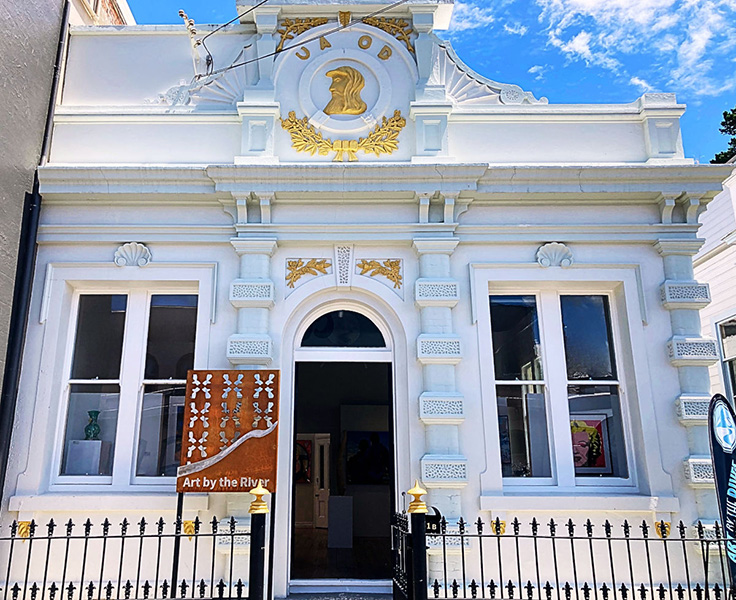
Art by the River is an independent contemporary gallery at 1B Bell Street in Whanganui, a few minutes from the Sarjeant. It opened in December 2024, timed to the Sarjeant’s reopening, and occupies the former U.A.O.D. Druids’ Chambers, an 1899 building in Greek style by the architect Wm. Pinches, its façade carrying the motto “United to Assist”.
The gallery holds more than 250 works by over 60 established and emerging New Zealand artists, alongside a collectables selection of works by internationally recognised names. It was founded by Richard Browes, who brings thirty years as a collector and dealer, a Master’s with First-Class Honours in Creative and Performing Arts, and credits including co-writing the documentary Colin McCahon: I AM. It is the sister gallery of Art by the Sea in Auckland.
Practically: layby terms are available, works can be purchased online with domestic and international shipping, and their artist and artwork pages carry the digital to-scale room mockup tool described above. Current exhibitions are listed on the site.
The gallery is open Wednesday to Friday 10am to 5pm, Saturday 10am to 4pm and Sunday 11am to 3pm, with Monday and Tuesday by appointment on 021 287 4229.